
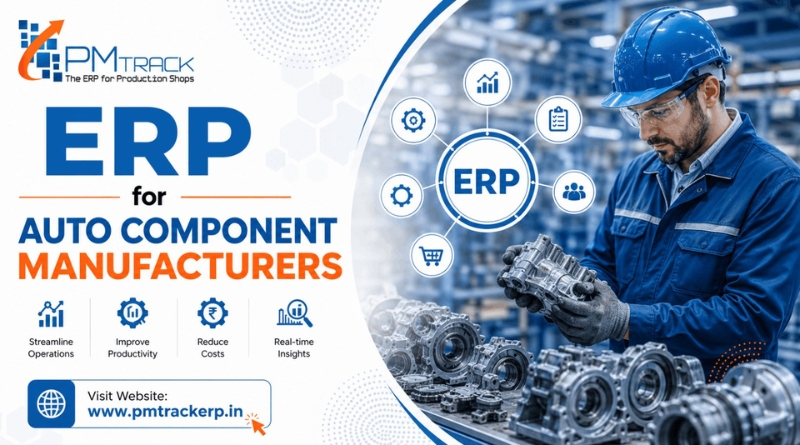
ERP for Auto Component Manufacturers: Complete Guide for 2026
Table of Contents
- Introduction
- What is ERP for Auto Component Manufacturers?
- Why Automotive Manufacturers Need ERP Software?
- Key Features of ERP Software for Auto Parts Manufacturers
- Benefits of Automotive ERP Solution
- How PMTrack ERP Helps
- How to choose the right ERP for Auto Components Manufacturers
- Conclusion
Introduction
The automotive component manufacturing industry is becoming more competitive, technology-driven, and quality-focused. Manufacturers today are expected to manage fluctuating customer demand, strict quality standards, complex production schedules, raw material costs, supplier coordination, traceability, and on-time deliveries—all while maintaining profitability. Traditional spreadsheets and disconnected software systems often struggle to handle these requirements efficiently.
This is where ERP for Auto Component Manufacturers becomes an important business solution. An ERP system connects production, inventory, purchasing, sales, finance, quality, maintenance, and other business functions through a centralized platform. For automotive manufacturers, this means better visibility, improved coordination, faster decision-making, and greater control over manufacturing operations.
What Is ERP for Auto Component Manufacturers?
ERP, or Enterprise Resource Planning, is an integrated business management system designed to bring multiple business processes onto a single platform. In the automotive component industry, an ERP system can help manufacturers manage everything from procurement and production planning to quality inspection, inventory control, dispatch, and financial reporting.
Automotive component manufacturing often involves multiple raw materials, production stages, machines, suppliers, customers, part numbers, revisions, and quality requirements. A specialized ERP system helps organize these processes and provides real-time information to management and operational teams.
Modern Automotive ERP Software for the Manufacturing Industry is designed to support the specific requirements of automotive suppliers, including production planning, bill of materials, material requirements planning, job work, inventory tracking, quality management, costing, and customer order management.
Why Automotive Manufacturers Need ERP Software
Automotive manufacturers operate in an environment where even a small production delay can affect deliveries and customer relationships. Manual data entry, duplicate records, and communication gaps can make it difficult to identify problems quickly.
An ERP system can provide a centralized view of operations and help manufacturers:
- Plan production more effectively
- Monitor raw material availability
- Control inventory levels
- Track work-in-progress
- Manage purchase orders and suppliers
- Monitor production costs
- Improve quality control
- Track customer orders and dispatches
- Generate accurate reports
- Improve coordination between departments
The biggest advantage of Automotive ERP Solutions is that different departments can work with connected information instead of maintaining separate records.
Key Features of ERP Software for Auto Parts Manufacturers
1. Production Planning and Scheduling
Production planning is one of the most important functions for auto component manufacturers. ERP software can help production teams plan jobs according to customer requirements, available materials, machine capacity, manpower, and delivery schedules.
2. Inventory Management
Managing raw materials, components, semi-finished goods, and finished products can become complicated when hundreds or thousands of items are involved.
ERP Software for Auto Parts can provide real-time inventory visibility, stock movement tracking, minimum and maximum stock levels, and material availability information. This helps manufacturers reduce excess inventory while avoiding production stoppages caused by material shortages.
3. Bill of Materials Management
Automotive components can have detailed manufacturing structures and multiple versions. ERP systems can manage Bills of Materials (BOMs), material requirements, and product revisions.
This allows production teams to work with accurate product information and helps reduce errors caused by outdated specifications.
4. Purchase and Supplier Management
An ERP system can connect purchasing activities with inventory and production requirements. Procurement teams can identify material requirements, create purchase orders, monitor supplier deliveries, and maintain supplier information.
This provides better control over procurement costs and delivery timelines.
5. Quality Management
Quality is critical in the automotive sector. ERP can support quality-related processes such as incoming material inspection, in-process inspection, final inspection, rejection tracking, and corrective actions.
By maintaining quality information within the ERP system, manufacturers can identify recurring issues and make more informed decisions.
6. Traceability
Traceability is increasingly important for automotive component manufacturers. Businesses need to know where materials came from, how products were manufactured, and where finished products were delivered.
An ERP Solution for the automotive industry can help maintain records related to batches, lots, production orders, materials, inspections, and dispatches, improving operational visibility and accountability.
7. Costing and Financial Management
Manufacturing profitability depends on accurate cost control. ERP systems can help businesses monitor material costs, production expenses, labor costs, overheads, and product-level costing.
Management can use this information to understand margins, identify cost increases, and make better pricing and production decisions.
8. Sales and Order Management
Automotive suppliers often work with recurring orders and customer-specific requirements. ERP software can help manage quotations, sales orders, delivery schedules, dispatches, and customer information.
When sales and production data are connected, production teams can plan according to actual customer requirements.
Benefits of Automotive ERP Solutions
Implementing an ERP system can provide several operational and strategic benefits.
Better decision-making: Management gets access to centralized and updated information, making it easier to monitor business performance.
Improved productivity: Automation reduces repetitive manual work and allows employees to focus on higher-value activities.
Reduced operational errors: Centralized data reduces duplicate entries and information gaps between departments.
Better inventory control: Manufacturers can monitor stock levels and material movements more efficiently.
Improved production visibility: Managers can track production progress and identify delays earlier.
Quality records can be maintained systematically for better analysis and corrective action.
Improved customer service: Better order and production visibility can support more reliable deliveries.
Cost control: Integrated costing and financial information helps businesses identify areas where expenses can be reduced.
How PMTRACK ERP Helps
PMTRACK ERP helps businesses streamline manufacturing operations through an integrated ERP environment designed to improve visibility, coordination, and efficiency. As an ERP for Auto Component Manufacturers, it connects key functions such as production, inventory, purchasing, sales, finance, and quality management. The platform also works as Automotive ERP Software for the Manufacturing Industry, helping manufacturers organize production workflows and monitor material requirements.
With Automotive ERP Solutions, businesses can improve process integration and access accurate operational information. It also supports ERP Software for Auto Parts manufacturers by helping manage inventory, procurement, production, and order-related activities. As an ERP Solution for the automotive industry, it provides a structured foundation for managing growing operations, improving productivity, and supporting better business decisions.
How to Choose the Right ERP for Auto Component Manufacturers
Before selecting an ERP system, manufacturers should evaluate their specific operational requirements. The right system should be practical, scalable, easy to use, and capable of integrating key business processes.
Consider the following factors:
- Manufacturing and production capabilities
- Inventory management features
- Purchase and supplier management
- Quality management
- BOM and material planning
- Costing and financial integration
- Reporting and analytics
- User accessibility
- Scalability
- Implementation and support
- Data security and backup
- Integration capabilities
Manufacturers should also consider whether the ERP provider understands the operational challenges of the automotive manufacturing sector.
Conclusion
The automotive component manufacturing industry is evolving rapidly, and manufacturers need greater control over production, inventory, procurement, quality, costing, and customer orders. The right ERP for Auto Component Manufacturers can bring these processes together, reduce manual work, improve visibility, and support faster, data-driven decisions.
With PMTRACK ERP, automotive manufacturers can streamline day-to-day operations, improve inventory and production management, strengthen process control, and gain better visibility across their business. Whether you are looking for Automotive ERP Solutions, ERP Software for Auto Parts, or a complete ERP Solution for the Automotive Industry, PMTRACK ERP can help create a more connected and efficient manufacturing environment.
Ready to modernize your automotive manufacturing operations? Choose PMTRACK ERP and take the next step toward smarter, more efficient, and scalable manufacturing. Contact PMTRACK ERP today to explore the right ERP solution for your business.



Leave a Reply