
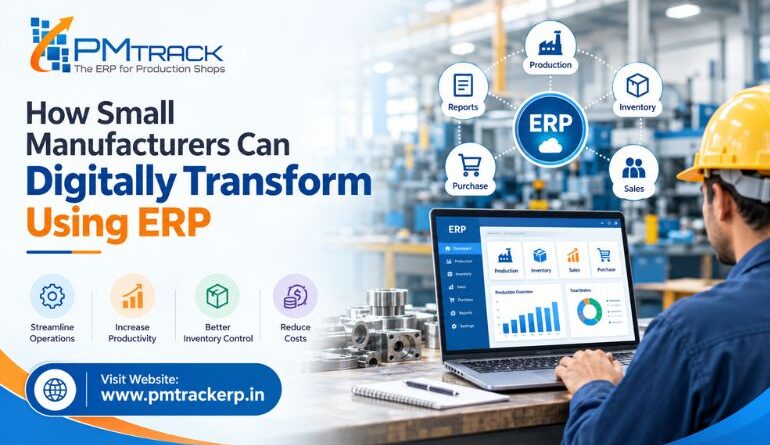
How Small Manufacturers Can Digitally Transform Using ERP
Table of Contents
- Introduction
- Why Do Small Manufacturers Need an ERP?
- How PMTrack ERP Helps
- Conclusion
Introduction
There is growing demand for small businesses to meet customer expectations, manage inventory, control costs, increase efficiency, and deliver goods on schedule. Using spreadsheets or disjointed systems to manage manufacturing, purchasing, inventory, sales, finance, and client orders can become challenging as firms expand.
Enterprise Resource Planning (ERP) software can be quite helpful in this situation. An ERP system helps manufacturers access accurate data and make better operational decisions by consolidating key business operations onto a single, centralized platform.
For small and growing businesses, implementing the best ERP software for small manufacturers does not necessarily mean adopting a complicated or expensive system. The ideal ERP can be practical, scalable, and customized to meet manufacturing needs.
A manufacturing-focused platform like PMTRACK ERP may help streamline day-to-day operations and lay out the groundwork for digital expansion for organizations searching for ERP software for manufacturing companies in Pune.
Why Small Manufacturers Need ERP
Many small manufacturing companies still depend on manual processes, spreadsheets, phone calls, and separate software applications. While these methods may work when operations are small, they can create challenges as production volumes and customer orders increase.
For manufacturing businesses, an ERP links several divisions and procedures into a single system. Businesses can use a single platform to handle information rather than keeping separate records for inventory, production, purchasing, sales, and accounting.
Some key reasons small manufacturers adopt ERP include:
- Better production planning
- Improved inventory visibility
- Centralized business data
- Faster access to reports
- Reduced manual data entry
- Better purchase management
- Improved order tracking
- Greater operational control
- More informed decision-making
ERP can assist manufacturers in transitioning from reactive management to more organized and data-driven operations by combining these procedures.
How ERP Digitally Transforms Small Manufacturing Businesses
1. Centralizes Business Information
One of the key advantages of an ERP system is centralized data. Sales orders, purchase orders, raw materials, production schedules, stock levels, and client needs are just a few of the information that manufacturing companies deal with.
This data can be combined into a single platform by ERP software for the manufacturing industry. Authorized users can access relevant data without repeatedly requesting information from different departments.
This improves communication and helps management get a clearer view of business operations.
2. Improves Inventory Management
For manufacturers, inventory control is essential. Inadequate raw supplies might halt production, while excess inventories can raise storage expenses.
Businesses may keep an eye on inventory levels, material needs, purchases, and consumption with the use of a manufacturing ERP system. Instead of depending solely on human calculations, producers may plan procurement based on operational requirements thanks to improved visibility.
Better working capital utilization and fewer needless inventory-related issues can result from this.
3. Streamlines Production Planning
Coordination of supplies, equipment, workers, timetables, and client demands are all part of production planning.
Manufacturers can arrange production-related data in an organized way with ERP. While management can keep an eye on developments, production teams can keep track of scheduled and ongoing tasks.
This degree of visibility can make it simpler for small enterprises to spot delays and adapt to shifting production needs.
4. Connects Sales and Production
Manufacturing schedules are directly impacted by sales obligations. There may be miscommunications and delays when the production and sales teams operate with different information.
For manufacturing businesses, an integrated ERP can link inventory and production procedures with client orders. This enhances departmental cooperation and helps businesses understand what must be produced and when.
5. Simplifies Purchasing
Another crucial aspect of manufacturing is procurement. Companies must buy raw materials in the proper amounts and at the right times.
Information on purchase orders, suppliers, material requirements, and stock levels can be provided by ERP to purchasing teams. As a result, the procurement process becomes less dependent on spreadsheets and human tracking and more structured.
6. Provides Real-Time Business Insights
For correct judgments, business owners require accurate data. However, it can take a long time to prepare reports by hand.
Dashboards and reports offered by contemporary ERP systems can assist management in keeping an eye on crucial operational data. Businesses can examine sales, inventory, purchasing, production, and other business processes, according to the ERP system.
Access to timely data can help small manufacturers identify operational issues and make informed decisions.
Choosing the Best ERP Software for Small Manufacturers
It takes significant thought to choose an ERP system. Small manufacturers should consider whether the software meets their real business needs rather than just how many features it has.
When assessing ERP software for manufacturing companies, consider elements like:
- Manufacturing-specific functionality
- Ease of use
- Scalability
- Inventory management
- Production planning
- Purchase management
- Sales management
- Reporting and analytics
- Integration capabilities
- Data security
- Implementation support
- Training and customer support
The right system should be practical enough for employees to use regularly and flexibly enough to support future business growth.
How PMTRACK ERP Helps
PMTRACK ERP is designed to support manufacturing businesses by bringing important operational processes together within an integrated ERP environment. For businesses searching for ERP software for manufacturing companies in Pune, PMTRACK ERP can provide a structured approach to managing manufacturing operations and business information.
As an ERP for manufacturing companies, PMTRACK ERP can help businesses improve coordination across different functions, including production, inventory, purchasing, sales, and other operational activities.
Its manufacturing-focused strategy can help businesses improve visibility throughout their processes and lessen reliance on disjointed systems.
A manufacturing ERP solution like PMTRACK ERP can help manufacturers in the following areas:
- Production planning and monitoring
- Inventory and stock management
- Purchase management
- Sales and order management
- Business reporting
- Centralized operational information
- Improved coordination between departments
Having connected information can assist developing manufacturers better analyze business performance and plan daily operations.
Businesses looking for a manufacturing ERP solution in Pune can evaluate PMTRACK ERP based on their specific processes, operational requirements, and future growth plans.
ERP’s Advantages for Small Manufacturers
Digital transformation does not always require replacing every business process at once. Small manufacturers can begin by integrating key operations and gradually expand their digital capabilities.
An ERP implementation can help businesses work toward:
Greater efficiency: Automated and organized workflows can reduce repetitive manual work.
Better visibility: Centralized information helps employees and managers access relevant business data.
Improved planning: Production, inventory, and purchasing information can be coordinated more effectively.
Reduced errors: Moving away from duplicate manual data entry can help minimize certain types of data-entry mistakes.
Scalable operations: A suitable ERP platform can provide a foundation for supporting increasing business volumes.
Data-driven decisions: Reports and dashboards can provide useful insights for operational and management decisions.
Conclusion
Digital transformation is becoming increasingly important for small manufacturing businesses that want to improve operational efficiency and manage growth effectively. ERP provides a way to connect essential business functions and create a centralized source of operational information.
From production planning and inventory management to purchasing, sales, and reporting, the right ERP software for manufacturing industry can help businesses organize their processes and improve visibility.
For manufacturers in Pune and other locations, choosing a manufacturing-focused platform is an important step toward building a more connected and data-driven operation. PMTRACK ERP can help businesses explore a structured approach to manufacturing management through an integrated ERP environment.
Ready to take your manufacturing business toward digital transformation?
Explore how PMTRACK ERP can support your production, inventory, purchasing, sales, and business management needs. Contact PMTRACK ERP today to discover a manufacturing ERP solution designed to support your business growth.




Leave a Reply