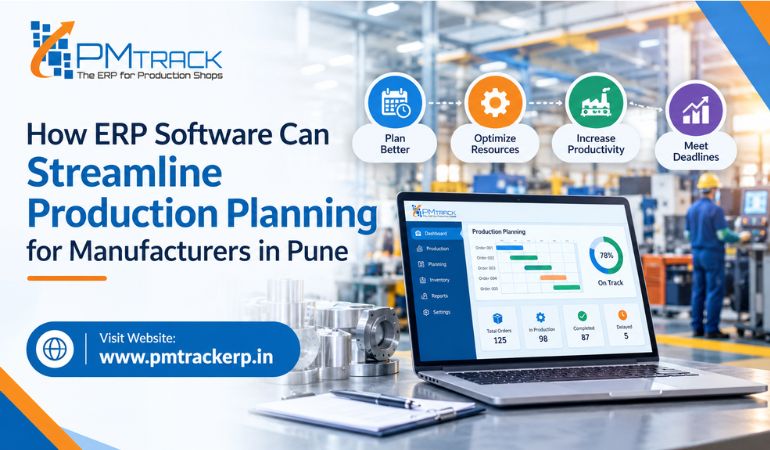
How ERP Software Can Streamline Production Planning for Manufacturers in Pune?
Table of Contents
- Introduction
- What is ERP-based Production Planning?
- How ERP Streamlines Production Planning?
- How PMTrack Helps
- Conclusion
Pune has developed into one of India’s important manufacturing hubs, with strong activity across automotive, engineering, machining, sheet metal, plastics, electronics, fabrication, and other industrial sectors. As manufacturers face changing customer demand, tighter delivery schedules, rising material costs, and increasingly complex production processes, traditional spreadsheets and disconnected systems can make production planning difficult.
This is where ERP software can make a significant difference. A modern ERP connects production, inventory, procurement, sales, quality, finance, and other functions within a centralized system, giving manufacturers better visibility and control over their operations. The reference article from Alligator Infosoft similarly highlights production scheduling, inventory management, real-time reporting, quality control, and integration as key areas where ERP can streamline manufacturing.
For Pune-based manufacturers, a properly implemented Manufacturing ERP Software in Pune can help turn production planning from a largely manual activity into a connected, data-driven process.
What Is ERP-Based Production Planning?
Production planning involves deciding what needs to be manufactured, how much needs to be produced, when production should take place, and what resources are required.
This includes:
- Raw-material availability
- Bill of Materials (BOM)
- Machine capacity
- Labour availability
- Production orders
- Work centres
- Inventory levels
- Supplier lead times
- Customer delivery schedules
- Quality requirements
When these activities are managed through separate spreadsheets or systems, production planners may have difficulty obtaining an accurate picture of the current situation.
An ERP Software for Manufacturers in Pune brings these functions together. Instead of relying on information from different departments, planners can work with centralized data and make production decisions based on current inventory, orders, materials, and capacity.
How ERP Streamlines Production Planning
1. Centralized Production Data
One of the biggest advantages of ERP is centralized information.
Sales teams may receive customer orders, procurement teams may manage suppliers, stores teams may monitor inventory, and production teams may manage work orders. Without integration, information can become fragmented.
ERP connects these activities so that production planners can see relevant information in one system.
For example, when a new customer order is confirmed, the system can connect the order with the required BOM, material requirements, inventory availability, and production planning process.
This reduces duplicate data entry and improves coordination between departments.
2. Better Material Requirements Planning
Material shortages can bring production to a standstill.
ERP systems with Material Requirements Planning (MRP) capabilities can calculate the materials and components required for planned production. The system can consider production requirements, existing stock, purchase orders, and other relevant data.
This allows manufacturers to identify potential shortages earlier and initiate procurement accordingly.
Modern Manufacturing ERP Solutions increasingly focus on connecting material planning with production and inventory rather than treating procurement as a separate activity.
PMTrack, for example, provides MRP, BOM, inventory, purchase, production, and warehouse functionality within its manufacturing ERP platform.
3. Improved Production Scheduling
Production scheduling becomes complicated when manufacturers have multiple machines, work centres, customer deadlines, and different production processes.
ERP can help planners organize work orders according to available resources and production requirements.
Instead of maintaining multiple Excel schedules, manufacturers can use a centralized production schedule to monitor:
- Planned production
- Work orders
- Machine utilization
- Material availability
- Production progress
- Pending jobs
- Delivery commitments
PMTrack’s production module supports generating work orders from production plans and tracking daily production, rework, machine utilization, and operator idle time.
4. Real-Time Inventory Visibility
Production planning is only as effective as the inventory information behind it.
If the system shows incorrect stock levels, planners may schedule production for materials that are unavailable or purchase materials that are already in stock.
ERP provides a common platform for tracking raw materials, work-in-progress, components, and finished goods.
This can help manufacturers reduce both excess inventory and unexpected stock shortages.
For Pune manufacturers operating multiple warehouses or production locations, ERP can also provide greater visibility across inventory locations.
5. Better Capacity Planning
Production capacity depends on more than the number of machines available. Manufacturers also need to consider labour, machine availability, production times, maintenance, and existing workloads.
ERP-based planning helps businesses understand whether available resources can support planned production.
If a particular work centre is overloaded, planners can identify the issue earlier and explore alternatives such as rescheduling, reallocating work, or outsourcing selected operations.
This can help reduce production bottlenecks and improve utilization of available resources.
6. ERP and the Rise of Smart Manufacturing
Production planning is also becoming more connected to newer manufacturing technologies.
According to Deloitte’s 2025 Smart Manufacturing Survey, 57% of surveyed manufacturers reported using cloud computing and data analytics at the facility or network level, while 46% were using industrial IoT solutions. The survey also identified advanced production scheduling as one of the leading investment priorities for the following two years.
AI is also increasingly being connected to manufacturing operations. A 2024–25 manufacturing AI survey reported that more than 77% of manufacturers surveyed had implemented some form of AI, while production and inventory management were among the reported application areas.
This indicates an important shift: manufacturers are increasingly looking for systems that do more than record transactions. They want connected data that can support planning, forecasting, monitoring, and decision-making.
For Pune manufacturers, this makes an integrated ERP Solution for Manufacturing Industry increasingly relevant as a foundation for broader digital transformation.
7. Improved Production Tracking
Planning does not end when a work order is created. Manufacturers need to know whether production is progressing according to schedule.
ERP can help track production status from planning through completion.
Managers can monitor:
- Work-order status
- Production quantities
- Rejected quantities
- Rework
- Machine utilization
- Operator performance
- Material consumption
- Pending operations
This gives production managers greater visibility into what is happening on the shop floor.
PMTrack also provides reporting capabilities for daily production, employee efficiency, rejection percentages, machine utilization, and job positions.
7. Better Coordination Between Departments
Production planning depends on multiple teams.
Sales needs to communicate customer requirements. Procurement needs to arrange materials. Stores needs to issue components. Production needs to manufacture the goods. Quality needs to inspect them. Finance needs to track costs and transactions.
When these functions operate independently, delays and communication gaps can occur.
ERP creates a shared information environment where departments can work with connected data.
This is particularly useful for growing companies looking for ERP software for manufacturing companies in Pune, where increasing order volumes and operational complexity can make manual coordination increasingly difficult.
How PMTrack Helps Manufacturers in Pune
PMTrack is a manufacturing-focused ERP platform designed around production-shop requirements. Its platform integrates areas including MRP, BOM, production, purchase, inventory, warehouse, sales, finance, CRM, and HR/payroll.
For production planning specifically, PMTrack supports features such as multi-level BOM, MRP, production planning, work orders, multiple plants, multiple warehouses, machine maintenance planning, traceability, and dashboards and alerts.
PMTrack also supports different manufacturing models, including make-to-stock, make-to-order, assemble-to-order, engineer-to-order, batch, mixed-mode, discrete, project-based, and job-work manufacturing.
This flexibility can be important because manufacturing businesses do not all follow the same production model.
For example, an automotive component manufacturer may require detailed BOM, MRP, quality, and traceability capabilities, while a job-work manufacturer may need stronger subcontracting and work-order controls.
PMTrack’s integrated approach is designed to connect planning, material management, production, subcontracting, quality, and business processes in one system.
For manufacturers evaluating the Best manufacturing ERP solution in Pune, the practical focus should therefore be on how well the ERP fits their actual production processes, rather than selecting software based only on a feature list.
What Manufacturers Should Look for in an ERP
Before selecting an ERP, manufacturers should evaluate:
- Production planning and scheduling
- BOM and MRP capabilities
- Inventory and warehouse management
- Machine and capacity planning
- Quality management and traceability
- Purchase and supplier management
- Production and machine reporting
- Integration between departments
- Scalability for future growth
- Implementation, training, and support
Customization and ease of adoption are also important. PMTrack highlights customized ERP capabilities for manufacturers in Pune because different manufacturing businesses have different workflows and operational requirements.
Conclusion
Production planning is becoming increasingly data-driven. For manufacturers in Pune, managing production through spreadsheets and disconnected applications can make it difficult to coordinate materials, machines, people, orders, and delivery schedules efficiently.
A modern ERP can bring these processes together, providing centralized data, MRP, inventory visibility, production scheduling, work-order tracking, quality information, and real-time reporting.
As smart manufacturing continues to evolve, ERP is also becoming an important foundation for technologies such as analytics, IoT, automation, and AI. For businesses evaluating Manufacturing ERP Software in Pune, the objective should be to select a system that fits their manufacturing model and can support both current requirements and future growth.
With its manufacturing-focused modules covering MRP, BOM, production, inventory, procurement, quality, reporting, and other business functions, PMTrack provides an integrated approach for manufacturers looking to improve production planning and operational visibility.
Ready to streamline your manufacturing operations? Explore PMTrack today and discover how a powerful manufacturing ERP solution can simplify production planning, improve visibility, and support your business growth. Contact PMTrack to schedule a personalized demo and see how the platform can fit your manufacturing requirements.
The right ERP Software for Manufacturers in Pune can help businesses move from reactive production management toward a more connected, organized, and data-driven manufacturing operation.