
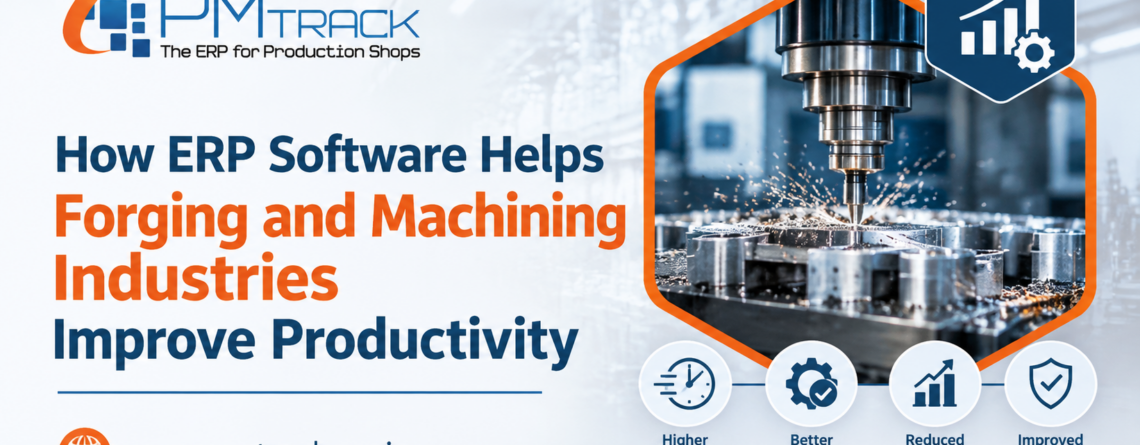
How ERP Software Helps Forging and Machining Industries Improve Productivity
Table of Contents
- Introduction
- Growing Need for ERP Software in Forging and Machining Industries
- Major Challenges Faced by Forging and Machining Manufacturers
- How PMTrack Helps
- Conclusion
The forging and machining industries play a crucial role in India’s manufacturing ecosystem, supplying essential components to automotive, engineering, construction, aerospace, and industrial equipment sectors. However, increasing customer expectations, rising raw material costs, production delays, machine downtime, and quality requirements are making manufacturing operations more challenging than ever.
For forging and machining manufacturers, maintaining productivity is not just about increasing production volumes. It also involves reducing material wastage, improving machine utilisation, managing inventory efficiently, maintaining product quality, and ensuring timely deliveries.
Traditional methods of managing production through spreadsheets and disconnected software applications can create operational difficulties. This is where ERP Software for the manufacturing industry becomes valuable. A modern ERP system integrates production, inventory, procurement, sales, quality, and financial operations into a single platform, helping manufacturers improve efficiency and make informed business decisions.
Growing Need for ERP Software in Forging and Machining Industries
India’s manufacturing sector is undergoing significant transformation, driven by automation, digitalisation, smart manufacturing, and increasing demand for precision-engineered components.
According to the Government of India’s Annual Survey of Industries (ASI) 2024–25, released in September 2026, India’s registered manufacturing sector recorded 9.59% growth in Gross Value Added (GVA), while industrial output increased by 7.81% compared with the previous year.
These developments highlight the growing importance of operational efficiency, production optimisation, and technology adoption in manufacturing.
For forging and machining companies, adopting ERP Software for Forging Industry in Pune can help streamline complex manufacturing processes, improve resource utilisation, and maintain better control over production activities.
Major Challenges Faced by Forging and Machining Manufacturers
Before understanding how ERP improves productivity, it is important to identify some common operational challenges.
- Complex Production Planning
Forging and machining businesses often manage multiple customer orders, production batches, machines, and manufacturing processes simultaneously. Manual scheduling makes it difficult to allocate resources effectively and meet delivery deadlines.
- Inventory Management Issues
Managing steel, billets, alloys, cutting tools, dies, and other raw materials requires accurate inventory information. Poor stock management can result in material shortages, excess inventory, and unnecessary purchasing costs.
- Machine Downtime
Unexpected machine breakdowns, poor maintenance planning, and inefficient machine utilisation can affect production capacity and increase operating expenses.
- Quality Control and Rejection
Maintaining consistent product quality is essential, particularly for automotive and engineering components. Inadequate inspection records and production monitoring can increase rejection rates and rework.
- Lack of Real-Time Information
When different departments maintain separate records, management may struggle to understand actual production progress, pending orders, inventory levels, and manufacturing costs.
An integrated ERP system helps address these challenges by connecting different business operations.
How ERP Software Improves Productivity in Forging and Machining Industries
1. Streamlines Production Planning and Scheduling
Production planning is one of the most important activities in forging and machining businesses. Manufacturers need to coordinate raw material availability, machine capacity, workforce, production orders, and customer delivery schedules.
ERP software simplifies this process by providing centralised production planning and work order management.
Manufacturers can:
- Generate production plans based on customer orders.
- Create and monitor production work orders.
- Track pending and completed jobs.
- Manage machine-wise production schedules.
- Monitor production progress.
- Improve coordination between departments.
With better production visibility, managers can identify bottlenecks and organise manufacturing activities more effectively.
2. Improves Raw Material and Inventory Management
Forging and machining operations require continuous availability of raw materials, components, and consumables.
ERP software provides centralised inventory management to monitor raw materials, work-in-progress (WIP), and finished goods.
It helps businesses maintain accurate stock records, monitor material movements, track minimum and maximum stock levels, and plan purchases according to production requirements.
Material Requirements Planning (MRP) also helps manufacturers calculate material requirements based on production schedules and Bills of Materials (BOM).
This reduces unnecessary purchasing, prevents material shortages, and supports better working capital management.
3. Enhances Machine Utilisation and Production Efficiency
Machine utilisation directly affects manufacturing productivity.
ERP systems help manufacturers monitor machine performance, production quantities, operator efficiency, and idle time. These insights allow production managers to identify underutilised machines and improve resource allocation.
For CNC and VMC machining companies, production monitoring can help identify delays, improve job scheduling, and monitor machine-wise performance.
Manufacturers can also use Overall Equipment Effectiveness (OEE) indicators to evaluate machine availability, performance, and quality.
4. Strengthens Quality Control and Traceability
Quality consistency is essential for forging and machining companies supplying automotive and industrial components.
ERP software supports quality inspection at different production stages, including incoming material inspection, in-process inspection, and pre-dispatch inspection.
Manufacturers can record rejection quantities, monitor rework, maintain inspection reports, and track quality-related information.
Where configured, batch and material traceability features also help connect production records with material lots and customer orders.
This improves accountability, simplifies quality monitoring, and supports customer audit requirements.
5. Reduces Production Costs and Material Wastage
Unplanned production activities, excess inventory, machine downtime, and repeated rework can increase manufacturing costs.
ERP software helps manufacturers monitor material consumption, production expenses, subcontracting costs, and job-wise costing.
By comparing planned costs with actual production costs, management can identify areas where resources are being wasted.
Better visibility into manufacturing expenses helps businesses improve cost control and make more accurate pricing decisions.
6. Improves Subcontracting and Vendor Management
Many forging and machining companies outsource activities such as heat treatment, surface finishing, electroplating, and specialised machining.
Managing outsourced operations manually can create difficulties in tracking material movement, vendor deliveries, and processing costs.
ERP software helps manufacturers manage subcontracting orders, track material sent to vendors, monitor pending returns, and record associated costs.
This improves coordination with suppliers and subcontractors while providing better visibility into outsourced production activities.
7. Enables Data-Driven Manufacturing Decisions
Smart manufacturing is increasingly focused on connected systems, automation, and data-based decision-making.
Modern ERP platforms provide dashboards and reports that help management monitor important business indicators, including:
- Daily production and rejection percentage.
- Machine utilisation and operator efficiency.
- Pending customer orders.
- Inventory and material availability.
- Production schedule compliance.
- Subcontracting status.
- Actual versus standard manufacturing costs.
These insights help business owners identify operational problems and take corrective action faster.
How PMTrack ERP Helps Forging and Machining Industries
PMTrack ERP is a manufacturing-focused ERP solution developed by Cloud9 Technologies to address the operational requirements of production-oriented businesses.
Designed for industries including hot, cold, and warm forging, machining, fasteners, automotive components, sheet metal, and engineering manufacturing, PMTrack brings important business functions together through an integrated platform.
Here is how PMTrack ERP helps improve productivity:
- Integrated Production Management
PMTrack helps manufacturers generate work orders based on production plans, manage material issues, record daily production, and monitor rework activities. It provides better visibility into ongoing jobs and production performance.
- Advanced Inventory and Material Management
The platform supports inventory management, procurement, warehouse operations, and material tracking. Manufacturers can monitor raw materials, work-in-progress, and finished goods more effectively.
- Machine and Operator Performance Monitoring
PMTrack provides reports covering machine utilisation, operator idle time, employee efficiency, and daily production performance. These insights help manufacturers identify productivity gaps.
- Quality Inspection Management
PMTrack supports incoming material inspection, in-process inspection, and pre-dispatch inspection. Businesses can track pending inspections, rejections, and rework to maintain better quality control.
- Subcontracting Management
The ERP helps manage outsourced manufacturing activities, including subcontracting challans, material movements, vendor purchase orders, and pending material returns.
- Real-Time Dashboards and Business Intelligence
PMTrack provides management dashboards for sales orders, production status, inventory, dispatches, machine utilisation, and operational performance. This helps management access relevant business information without depending on multiple disconnected reports.
- Integrated Business Operations
With modules covering production, MRP, BOM, purchase, inventory, sales, finance, CRM, and HR/payroll, PMTrack helps businesses connect important operational activities through a unified ERP platform.
For manufacturers looking for ERP Software for Forging Manufacturers or the Best ERP Software for Machining Companies in Pune, PMTrack offers manufacturing-oriented functionality that can be evaluated according to individual production requirements.
Conclusion
Improving productivity in forging and machining industries requires more than increasing machine capacity or hiring additional employees. Manufacturers need better control over production planning, inventory, machine utilisation, quality, subcontracting, and operational costs.
Implementing the right ERP system helps connect these activities, reduce manual work, improve information flow, and provide greater visibility into manufacturing operations.
As Indian manufacturing moves towards smart manufacturing and digital transformation, adopting ERP Software for the manufacturing industry can help forging and machining businesses become more organised, efficient, and competitive.
PMTrack ERP provides an integrated manufacturing management solution designed to support the requirements of forging, machining, and engineering businesses.
Looking to improve production efficiency and gain better control over your manufacturing operations?
Choose PMTrack ERP and take the next step towards smarter manufacturing!
Contact PMTrack today to schedule a personalised demo and discover how the right ERP solution can support your business growth.








Leave a Reply